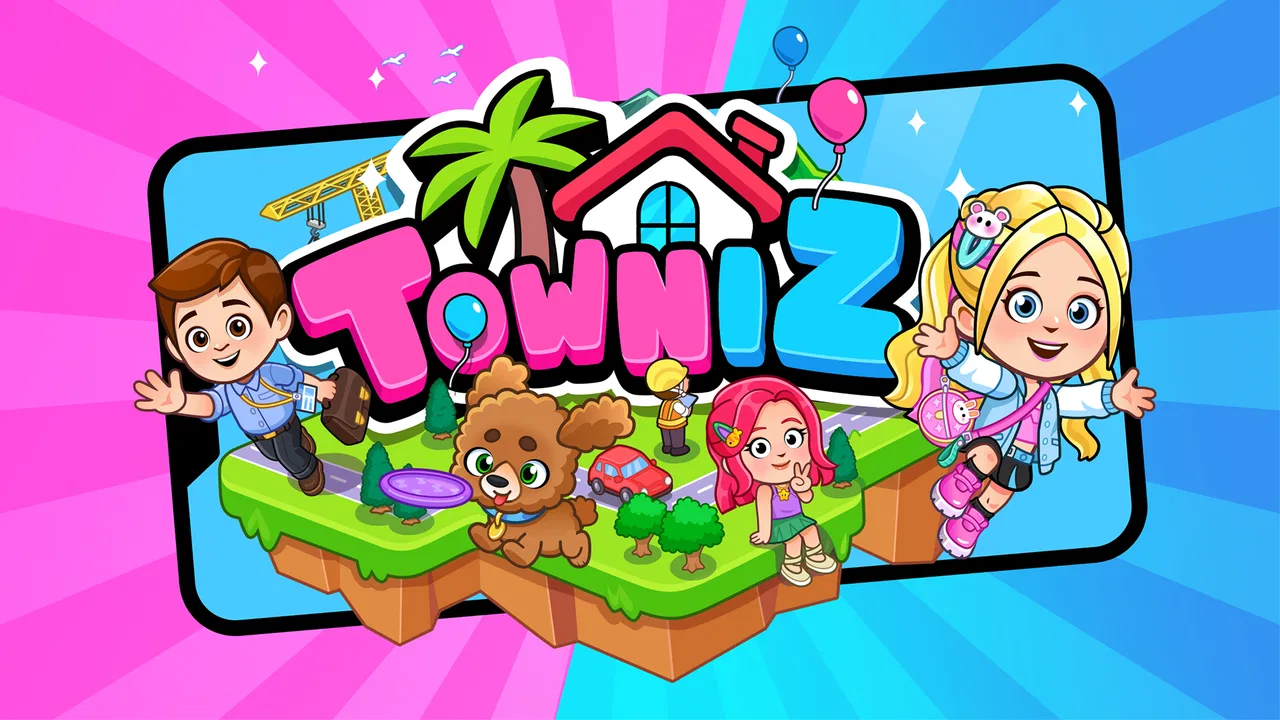
Towniz World: Avatar Life
- 4.4
- Rating
- 1.00M
- Installs
- Free
- Price

 Analysis by App-foxy
I spent my first sessions with Towniz World: Avatar Life treating it less like a traditional role-playing game and more like a small, playable world I could arrange at my own pace. That distinction matters. This is not the kind of RPG I would choose for deep combat, complex character statistics, or a tightly scripted campaign. Its appeal comes from exploring, creating little situations, and deciding what kind of day my avatar is having. The relaxed format makes it easy to understand, especially if you want something approachable rather than demanding.
My first impression was positive because the game gives me room to experiment without forcing me into a difficult opening. I could move around, inspect the available spaces, and build my own reasons to return. That freedom is also the central question for long-term use: once the first wave of curiosity passes, does the world still give me enough to do? After looking at it through that lens, I think the answer depends heavily on whether you enjoy imaginative play and making your own stories.
What the first week feels like
The opening appeal of this role-playing game is its low pressure. I do not have to learn a complicated combat loop before enjoying it, and the general idea is easy to explain to another person. You enter a world designed for movement, discovery, and personal expression, then turn ordinary spaces into scenes for your own play. That makes the game especially comfortable for short visits, when I want to do something creative without committing to a long session.
You May Also Like

 Blood Strike: 2.5 Anniversary
Blood Strike’s Loadouts Turn Every Drop Into a Tactical Gamble
A close look at Blood Strike’s custom loadouts: how fast access to signature weapons reshapes its battle royale rhythm, rewards preparation, and narrows the gap between fights.

 Pandora - Music & Podcasts
Pandora’s Music Is Easy to Start, but Harder to Recover
Pandora’s strength is its low-effort path from a seed to a station. Its weak spot is how much confidence it asks you to place in connection, setup, and quiet recovery.

 8 Ball Pool
 Is Built on Rivalries, Rematches, and Routine
A close look at the rivalries, rematches, shared routines, and unanswered safety questions that turn a quick pool match into a persistent mobile community.

 Samsung Music
’s Quiet Strength Is Playing What You Already Own
Its reach comes less from spectacle than from dependable access to a personal library. That simplicity is both the app’s strongest retention engine and its ceiling.

 AccuWeather: Weather Radar
AccuWeather Review: A Quick, Clear Forecast for Everyday Decisions
For everyday plans, the best forecast is the one you can understand quickly. AccuWeather makes rain timing, radar, and local conditions easy to act on, with a few trade-offs.

 Hill Climb Racing
Why Hill Climb Racing Still Turns Crashes Into One More Run
A tiny car, a bumpy hill and one more upgrade: Hill Climb Racing keeps resurfacing because its simple chaos makes every near-miss feel personal.
More From Our News Desk
View All News


During the first few days, I found myself testing possibilities simply because the world invited me to look around. A room could become a home, a meeting place, or part of a story I was inventing. The useful mindset is to stop waiting for the game to hand me a single objective and instead use the available environment as a set of prompts. If you approach it expecting a conventional quest chain, the experience can feel lighter than expected; if you enjoy arranging scenes and imagining what happens next, the same simplicity becomes its strength.
The avatar-focused format also makes the game easy to share. A younger player can understand the basic idea quickly, while an older player may enjoy setting up humorous situations or experimenting with different ways to present a character. The age rating of Everyone reflects that broad accessibility. I would still recommend that parents look at the in-app purchase setup before handing over a device, but the core presentation is much less intimidating than a typical fantasy RPG with battles and complicated progression.
One practical tip improved my early sessions: I stopped trying to inspect every area in one sitting. Instead, I chose a small scenario, such as preparing a character for a visit or organizing a room, and used that as a reason to explore. This gave each session a beginning and an end. Without that self-imposed structure, the freedom can become wandering, and wandering is fun only while the novelty is fresh.
The game is free to start, which lowers the barrier to trying it. Optional purchases range from less than a dollar to several dollars per item, so I would not describe it as automatically expensive, but I would also avoid assuming that every available element belongs to the free experience. The best way to judge it is to play the basic version first and ask whether the creative loop already feels satisfying. If it does, additions may feel worthwhile; if it does not, buying more content is unlikely to solve the underlying problem.
Why the first sessions work
The strongest early quality is immediacy. I can understand the appeal without reading a long explanation, and the game does not require me to become an expert before I can make something enjoyable. That is useful for families sharing a tablet, casual players who dislike pressure, and anyone looking for a digital dollhouse-style experience with role-playing elements.
Another advantage is that the game leaves space for different kinds of play. I can focus on appearance and presentation, invent a small story, or simply explore when I have a few spare minutes. This flexibility gives it more personality than a game that only rewards completing identical tasks. I especially liked that I could decide what counted as a successful session. Sometimes it was discovering a new interaction; other times it was arranging a scene that looked right to me.
There is a trade-off, though. Player-made goals are liberating only when I am in the mood to create them. On a tired day, I may prefer a game with a clear mission, a visible reward, and an obvious next step. Towniz World does not replace that kind of RPG. It offers a calmer alternative, and that means its first-week appeal is strongest for people who want a playground rather than a checklist.
What remains after the novelty fades
Long-term value in a game like this cannot be measured only by how much content I notice during the first few days. The more important question is whether I can keep generating fresh situations without feeling that I am repeating the same performance. In my experience, the answer is possible but not automatic. The world supplies a base for recurring play, while I supply much of the variation.
A realistic everyday use case is a short evening visit after work or school. I might open the game, choose one character, and create a simple scene around a routine event: getting ready, meeting someone, changing a room, or exploring an area with a specific purpose. That kind of session can be relaxing because there is no need to defend a streak or catch up with other players. I can leave after a few minutes and return later without feeling punished for taking a break.
For children, the repeated value may come from storytelling. One day the same spaces can support a family scene; another day they can become the setting for an imaginary adventure. For adults, the appeal may be closer to casual creative play: arranging visual details, testing combinations, and using the avatar as a way to act out a mood or idea. The game is most durable when the player enjoys this process itself, not when they are waiting for a deep progression system to appear.
A second useful approach is to rotate the purpose of each visit. I found it more rewarding to alternate between exploration, character-focused play, and setting up a scene than to repeat one action until it became routine. This is a small habit, but it addresses one of the game’s central weaknesses: because the structure is open, repetitive play can become self-imposed. Giving each session a different theme helps preserve the sense of discovery.
Sharing also affects its lifespan. The store summary presents the idea of playing, exploring, and sharing your world, and that sharing angle makes sense when another person is willing to look at your creations or participate in the story. Even without treating it as a competitive social game, showing a scene to a sibling, friend, or parent can turn a solitary activity into a conversation. If you always play alone and do not enjoy inventing narratives, the same feature set may feel less compelling over time.
The audience response suggests that the game has found a substantial casual audience: it has passed one million installs and holds a 4.1 average rating from roughly 3,700 ratings. Those figures do not decide whether it belongs on your device, but they fit my experience of a game that is easy to approach and broadly understandable. I would read the rating as evidence of a generally positive reception rather than a promise that every player will find enough depth for months.
Where it sits among other role-playing games
Compared with a story-driven RPG, Towniz World: Avatar Life gives me far less reason to chase a final outcome. There is no need to prepare for a major battle or optimize a character build in the way I would in a traditional adventure. That makes it friendlier for relaxed play, but it also means players who want challenge, tactical decisions, or a strong narrative arc should look elsewhere.
Compared with a life simulator, its appeal is more focused on immediate imaginative interaction than on managing a detailed long-term routine. I do not open it because I need to balance a schedule, build a career, or maintain a complex economy. I open it to play with a world and its characters. That difference makes it a better choice for quick creative sessions and a weaker choice for anyone seeking a simulation that steadily develops through systems and consequences.
Compared with a purely decorative avatar app, the role-playing label is useful because the environment gives me a reason to act out scenes rather than only change a character’s appearance. Still, I would keep expectations realistic: the game’s lasting value comes from what I imagine and construct, not from an endless stream of dramatic plot twists.
The maintenance cost of keeping it interesting
The main maintenance burden is not technical complexity; it is creative energy. I have to bring a little intention to each session. If I simply open the game and wait for a strong objective to appear, I can run out of momentum quickly. If I arrive with a small idea, the same world becomes much more useful. This is an important distinction for anyone deciding whether a free game deserves permanent space on a phone.
I recommend keeping a short list of scene ideas outside the game. They do not need to be elaborate. A new arrival, a room makeover, a family gathering, or an unexpected meeting can be enough to give an otherwise quiet session direction. This workflow is more effective than trying to force a long play period, because the game works best when the player treats it as a creative break rather than a daily obligation.
Another maintenance issue is device compatibility. The current version is 1.12.13 and requires at least Android 8.1, so anyone using an older Android device should check compatibility before planning around it. For supported devices, I would still keep normal expectations for a free mobile game: available space, battery, and the age of the phone can affect how pleasant any session feels. I would not choose it as a primary game for an outdated device without testing it first.
The purchase model deserves practical attention as well. Since individual in-app purchases can cost between $0.99 and $6.99, I would set purchase controls before letting a child explore independently. I also think the free portion should be evaluated on its own terms. A game that is enjoyable only after buying several extras may not be a good fit for a family trying to keep mobile entertainment simple. On the other hand, modest optional purchases can be reasonable for a player who has already confirmed that the basic creative loop is a good match.
Maintenance also means accepting that there may be stretches when I do not feel like opening it. That is not necessarily a failure. This is a game I would keep for occasional imaginative sessions, not one I would force into a daily routine. Its relaxed design makes it easy to leave and return, but it does not create the same urgency as games built around timed events, competitive rankings, or constant progression.
What can cause fatigue
The first source of fatigue is repetition without a new personal idea. Exploring the same spaces can be enjoyable while I am still discovering possibilities, but the activity loses energy if I keep expecting the environment alone to entertain me. The game’s openness is both its creative advantage and its main limitation. It gives me freedom, but it also transfers responsibility for variety to me.
The second source is a mismatch of expectations. Someone searching for a serious RPG may be disappointed by the lack of emphasis on combat, statistics, or a demanding campaign. Someone who wants a highly structured life simulator may also find the experience too loose. I would skip this game if my priority were measurable progression, strategic difficulty, or a story that carries me from one major chapter to the next.
There is also a social limitation in the broad sense of the word. Sharing a world is more rewarding when I have someone interested in seeing what I made. If I prefer private, goal-driven play, that part of the experience may not add much. The game can still work alone, but I would not choose it specifically for competitive multiplayer or a deep online community.
Finally, optional purchases can interrupt the feeling of a simple, open-ended toy if I start treating every unavailable item as necessary. My advice is to decide early whether I am playing with the free tools or budgeting for extras. That small boundary prevents the game from turning a relaxing session into a series of purchase decisions.
My long-term verdict
After the novelty fades, Towniz World: Avatar Life earns space on my device only if I value self-directed storytelling. I would recommend it to a friend who wants an accessible avatar game for short creative breaks, family play, or relaxed exploration. The Everyone age rating, free entry point, and simple role-playing format make it easy to try, while the ability to invent personal scenarios gives it more staying power than a purely passive character editor.
I would not recommend it to a player who needs a strong reward loop to return every day. It is also a poor substitute for a traditional RPG with challenging battles or a life simulator built around detailed management. Those games provide structure that this one intentionally leaves in the player’s hands. Choosing the right alternative depends on whether I want to create the reason to play or receive that reason from the game.
My most honest recommendation is to test the first sessions with a specific routine rather than browsing aimlessly. Pick one character, one setting, and one small story. If that simple exercise feels satisfying, the game has a realistic chance of becoming a pleasant recurring habit. If it feels empty even when I provide the premise, I would move on instead of assuming more purchases will create depth.
The developer, My Town Games Ltd, has positioned this release as a welcoming world for play, exploration, and sharing. In my experience, that description works best when understood as an invitation to make your own entertainment, not as a promise of an endlessly expanding RPG campaign. Its lasting value comes from creative reuse, not forced daily progression. That makes it a worthwhile free download for the right player, but a temporary curiosity for anyone who needs constant novelty or a clearly guided adventure.
For me, the final decision is a qualified yes. I would keep it available for relaxed sessions and shared storytelling, especially when I want something gentle and easy to pick up. I would not make it my only mobile game, and I would set clear boundaries around optional purchases. With those expectations, Towniz World: Avatar Life feels less like a game I must maintain and more like a small creative space I can revisit whenever I have a new scene in mind.
FAQs for Towniz World: Avatar Life
01What is Towniz World: Avatar Life?
Towniz World: Avatar Life is a vibrant social simulation game where players create and customize their avatars to explore a lively virtual world. Engage with other players, complete quests, and participate in fun activities. Whether you’re decorating your home or attending virtual events, the game offers a dynamic environment for creativity and social interaction.
02Is Towniz World: Avatar Life available on both Android and iOS?
Yes, Towniz World: Avatar Life is available for download on both Android and iOS platforms. You can find it on the Google Play Store for Android devices and the Apple App Store for iOS devices. Ensure your device meets the necessary system requirements for optimal performance.
03What are the in-app purchase options in Towniz World: Avatar Life?
Towniz World: Avatar Life offers a variety of in-app purchase options to enhance your gaming experience. Players can buy virtual currency to acquire exclusive outfits, decorations, and other premium items. While the game is free to play, these purchases can help personalize your avatar and expand your virtual world.
04How can I customize my avatar in Towniz World: Avatar Life?
Customization is a key feature in Towniz World: Avatar Life. Players have access to a wide range of options including hairstyles, outfits, and accessories to create a unique avatar. Additionally, you can decorate your virtual home with various furniture and items, allowing for endless personalization possibilities.
05Is Towniz World: Avatar Life safe for children to play?
Towniz World: Avatar Life is designed to be family-friendly and suitable for players of all ages. It includes features to ensure a safe environment, such as moderated chat options and parental controls. Parents are encouraged to review the game's settings to tailor the experience to their child’s needs.
Pros
- Highly customizable avatars.
- Engaging social interactions.
- Vibrant virtual world.
- Regular events and updates.
- Easy-to-navigate interface.
Cons
- In-app purchases can be pricey.
- Occasional connectivity issues.
- Limited offline play options.
- Ads can be frequent.
- High battery consumption.

Towniz World: Avatar Life
Gallery